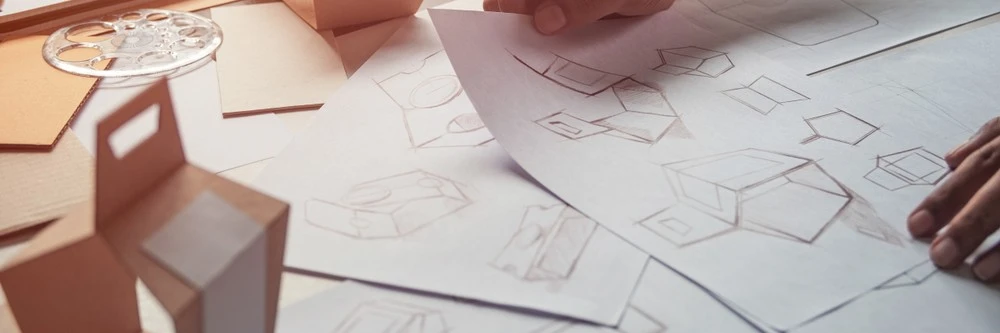
Design law
Design law protects industrial design. This includes both two-dimensional and three-dimensional designs that are not intended to function as trade marks.
In principle, to claim design rights, you must register the design (with an exception for the unregistered EU design).
Two-dimensional designs
You naturally know what a drawing is. However, not every drawing is protected by design law. In this context, two-dimensional designs include patterns for textiles, designs for fabrics, wallpaper or tiles. They therefore concern all two-dimensional (2D) aspects of industrial design.
Three-dimensional designs
Three-dimensional designs (3D) concern the protection of the overall appearance of an object, such as a knife block, television or door handle.
- Constructions, including the underlying construction and functional design, are not protected by design rights.
- Design rights protect designs with a new and original ornamental appearance. In this respect, similar considerations arise to the requirements imposed on a work under copyright law.
- Objects with a purely decorative function may also be protected by design rights. Examples include ornaments, sculptures, paintings and even prints.
- A design school or style, with a particular approach or idea regarding design, is not protected by design rights. Protection must therefore relate to a specific design. Such a design may, however, be the result of a particular design school or approach.
Design law therefore has requirements comparable in some respects to those found in trade mark law. It is concerned with protecting specific designs. Would you like to know how you can obtain protection for a design? Contact one of our design lawyers straight away.

Appearance, individual character and novelty are the requirements for protection of a design
Three requirements apply to the protection of a design
- Appearance. The appearance of a design is protected as a whole. This concerns in particular its lines, colours, contours, shape, texture or materials. The appearance is the combination of these and other features.
Where the appearance is dictated solely by the technical function, protection under design law is excluded.
- Individual character. Individual character is assessed against other designs that have already been made available. The standard is the overall impression produced on the informed user. To what extent is the informed user able to distinguish between the designs?
- Novelty. A design is considered new if no identical design has been made available to the public before the filing date.
- A design is considered new where it differs from earlier designs in material respects. If there are only very minor differences from an earlier design, it will not be considered new.
- A design is deemed to have been made available to the public if it has been marketed, exhibited or otherwise disclosed. However, this does not apply where the designer has disclosed the design themselves during the 12-month period preceding the filing date.
Benelux and international design rights
As with trade marks, designs can be registered in the Benelux. This provides design protection in the Netherlands, Belgium and Luxembourg.
International registrations are often more complex and are generally handled through Geneva. However, it is not always straightforward to determine the circumstances in which a design will be protected. We therefore recommend that you always seek advice from our design law specialists.


This could also be interesting for you



Get in touch
Do you have any questions or would you like to make an appointment? Get in touch with us, without any obligations.
- Haagweg 1492321 AA, Leiden